













This project required precise manual annotation, a deep understanding of plant growth processes, and a continuous, structured communication cycle
with the AgwaFarm team.
-
Accurate detection and boundary annotation
Keymakr performed object detection by marking plants in the pots with bounding boxes and identifying the boundaries of each sprout.
The team worked with video datasets that essentially consisted of 9–10-frame sequences capturing different growth stages. By analyzing plant dynamics
frame by frame, annotators could identify early development stages that would be nearly impossible to detect from a single static image.
-
Growth-stage classification
Beyond detection, a key component of the work was classifying growth stages through attribute labeling. The team identified the pot state (“new,” “old”)
and recorded the plant’s development stage, from germination to more mature phases. AgwaFarm used this data to automate lighting adjustments, water
delivery, temperature control, and likely nutrient dosing.
Visual ambiguity necessitated careful attention. The task was not simply to select a category but to accurately interpret what was happening inside each
module.
-
Flexibility and communication are the foundation of quality
A defining element of the project was the close and well-coordinated communication between both teams. There were many instances when the
AgwaFarm team verified annotations directly against the live plants, helping refine complex boundary cases.
Despite the relatively small volume of data, the project was more complex than many large-scale annotation initiatives. It was a detailed, low-volume
pipeline where standards for attention and quality had to be maintained at all times.
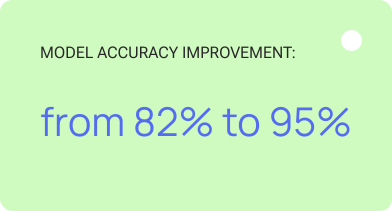
According to AgwaFarm’s report, the accuracy of their algorithm improved from 82% to 95%, which is a significant advancement for agritech applications.