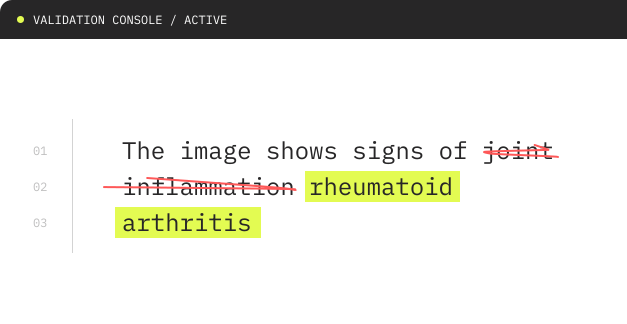















header object

Medical & Healthcare

Our data annotation services cover the full spectrum of medical LLM applications that provide diagnostic support, pharmaceutical analysis, and personalized patient care.

Talk to an expert

Human experts from Healthcare

Physician

Annotates diagnoses, symptoms, laboratory results, and medical procedures in texts.

Get In Touch

Clinical Staff

Helps annotate patient care practices, prescribing, and monitoring data.

Get In Touch

Pharmacist

Annotates medication, dosage, interactions, and contraindications.

Get In Touch

Medical Researcher

Annotates scientific articles, clinical trials, and protocols.

Get In Touch

Clinical Data Analyst

Validates structured data, normalize terms, and prepare a database for LLM.

Get In Touch

Compliance Expert

Ensures confidentiality, HIPAA compliance, and other requirements during annotation.

Get In Touch
Looking for
custom solutions?

LLM Data Types for the Healthcare Industry

Named-Entity Recognition (NER)

Highlighting medical terms, diagnoses, medications, procedures, and laboratory values in text. Allows the model to correctly recognize key medical concepts and structure information for analysis.

Bounding box annotation icon

Symptom & Diagnosis Annotation

Annotating symptoms, examination results, and established diagnoses in medical records. Helps LLM accurately correlate symptoms with possible patient conditions.

Polygon annotation icon

Treatment & Prescription Annotation

Annotating procedures, treatment regimens, dosages, and prescriptions in medical documents. Helps the model generate recommendations and support clinical decisions.

Semantic segmentation icon

Lab & Test Results Annotation

Laboratory test, x-ray, MRI, and other diagnostic test results. The model will learn to correctly interpret numerical and text data for medical analysis.

Skeletal annotation icon

Medical Context & History Annotation

Extracts information about a patient’s past medical history, allergies, chronic conditions, and other medical factors. Teaches LLM to take individualized recommendations into account.

Cuboid annotation icon

Question/Answer Annotation

Annotates question-answer pairs to train models to respond to medical queries from patients and specialists. LLM can provide accurate and reliable answers to clinical and informational questions.

Key points annotation icon

How reliable are your LLM Agents, really? Let’s run a Hallucination Audit

Learn more

LLM Data Services for Medical & Healthcare

Domain Data Collection and Cleaning

Generation, collection, and standardization of large amounts of specialized data for model training.

Bounding box annotation icon

Specialized Data Annotation

Engaging experts to label data to transform input into structured training material.

Polygon annotation icon

Model Fine-Tuning

Adapting generic LLMs to client-specific data so that the model better understands industry terminology and context.

Semantic segmentation icon

Accuracy and Hallucination Audit

Systematically checking the model’s generated responses for factual inaccuracy and fabricated information (hallucinations) to ensure reliability.

Skeletal annotation icon

Prompt Engineering

Development and optimization of prompts to maximize the quality and predictability of the model’s output.

Cuboid annotation icon

LLM Monitoring and Support

Continuous monitoring of model performance in a production environment, tracking data drift and using feedback for regular updates.

Key points annotation icon

Reviews
on

down-line
g2
star
star
star
star
star

"Delivering Quality and Excellence"

The upside of working with Keymakr is their strategy to annotations. You are given a sample of work to correct before they begin on the big batches. This saves all parties time and...

star
star
star
star
star

"Great service, fair price"

Ability to accommodate different and not consistent workflows.
Ability to scale up as well as scale down.
All the data was in the custom format that...

star
star
star
star
star

"Awesome Labeling for ML"

I have worked with Keymakr for about 2 years on several segmentation tasks.
They always provide excellent edge alignment, consistency, and speed...

Talk to a solution architect and discover how high-quality data can help improve your model performance!

Talk to Anna

LLM Use Cases in Medical & Healthcare

Clinical Decision Support

With LLM, healthcare professionals have instant access to structured clinical knowledge derived from medical records, recommendations, and research. They analyze a patient’s symptoms, test results, medical history, and outputs from physical AI devices such as imaging scanners and monitoring equipment to make informed decisions. As a result, LLMs can:

Suggest potential diagnoses
Recommend treatment options
Identify clinical risk factors

Automate medical records

Medical teams transform unstructured clinical records into clear, standardized documentation using automated LLM. This reduces administrative burden and improves data consistency across healthcare systems. As a result, LLMs can:

Generate clinical reports
Structure electronic medical records
Synthesize physician records

Personalized patient care

With LLMs, healthcare professionals can provide personalized recommendations based on each patient’s data. Models analyze medical history, lab results, lifestyle, and continuous inputs from embedded AI wearable devices for real-time monitoring to create personalized care plans. As a result, LLMs are able to:

Create personalized health recommendations
Recommend preventive actions
Support long-term care plans

Telemedicine and chatbots for patients

LLMs help patients get reliable answers to their medical questions at any time. They reduce the workload on staff and maintain consistent communication quality. As a result, LLMs are able to:

Answer patient inquiries
Explain medical procedures
Support the appointment and care process

Medical research and knowledge discovery

Researchers can quickly analyze large volumes of medical literature and clinical data. Models identify key findings and emerging trends. As a result, LLMs are able to:

Synthesize scientific articles
Identify research patterns
Support evidence-based medicine

Health monitoring and risk prevention

Healthcare organizations proactively monitor patient data using physical AI medical devices and process part of this data locally with embedded AI systems for low-latency alerts. Continuous analysis enables early intervention and improves patient safety. As a result, LLM programs are able to:

Identify early warning signs
Predict health risks
Support preventive care strategies

FAQ

How do LLMs analyze medical records?

LLMs analyze medical records by processing expert-annotated clinical data. High-quality annotations ensure that the model accurately interprets the patient’s diagnoses, procedures, and medical history.

Why is human annotation necessary in medical LLM projects?

Human annotation provides clinical validation, reduces errors, and ensures compliance with medical standards. Only healthcare professionals can accurately interpret complex medical data.

How does medical data annotation improve patient safety?

Medical data annotation helps LLMs identify risks and important clinical signals. This leads to robust decision support systems and safe healthcare recommendations.