














header object

How a global technology
company used Keymakr
for traffic detection at
scale

Automotive

Services:
Overview:

Intro

A multinational enterprise that builds tools for ADAS needed expert annotation of road-scene imagery and video to strengthen AI models. The organization aggregates visual and sensor data from diverse geographies and operating conditions, and requires outputs that could be aligned to its internal pipelines and reviewed under strict quality thresholds.

In this case, the company needed highly accurate traffic imagery and video annotation to train and refine AI models for environmental perception. The goal was to ensure that systems could correctly identify lane markings and conditions across different regions, a critical step in building reliable, real-world-ready mobility solutions.

The challenge

Autonomous vehicle systems depend on precisely labeled training data to interpret and respond to real-world conditions. In this project, the work involved managing multiple layers of image and video data, with variations across many factors. The complexity was intensified by several key challenges:

Continuous model
refinement

The project required regular retraining based on new inputs and field test results. This created an ongoing demand for data validation and labeling, not just any annotation, but expert-level precision aligned with evolving requirements.

Critical precision in an
automotive context

In automotive AI, even minor annotation errors can have serious consequences. Mislabeling a traffic sign or failing to notice an animal on the road might mislead a model controlling a self-driving system. Accuracy was vital.

Region-specific
data

The annotation team needed to accurately identify and label region-specific data because the system was deployed in multiple regions, each with unique traffic signage, layouts, and movement patterns.

High volume,
tight timelines

Workflows often required processing large-scale datasets under tight deadlines — up to 200,000 object instances (appearances of objects in individual images) within a 6-7 day turnaround, all while maintaining strict quality standards.

Scalability
bottlenecks

Part of the annotation workflow was initially executed on an open-source tool. However, when scaling was attempted, the system began to lag and limit productivity. A scalable, flexible solution was needed to support large, concurrent teams efficiently.

The solution
Phase 1. Output validation
Over 200,000 pre-annotations had to be reviewed and corrected, all within just 7 days.

The client’s own model was developed to detect and interpret traffic-related events. While it performed adequately in standard scenarios, human review was essential to catch subtle recognition errors, especially in edge cases where inaccuracies could impact downstream systems for driver assistance.

Our team responded immediately:

  • A dedicated group of 80 trained operators was assembled to work on the project.
  • Human validation identified a range of small but critical data inconsistencies, significantly improving the final dataset’s accuracy.
  • Validated results were exported into tailored outputs, pre-structured to match the client’s specific internal processes.

This pilot phase proved the ability to combine speed, precision, and adaptability. It also demonstrated that large-scale validation could be executed under extreme time constraints without sacrificing quality.

Phase 2. Scaling the labeling efforts

The next stages required providing labeling from scratch across a diverse set of object categories and environments, such as:

  • Traffic labeling
  • Object detection
  • Street signage
  • Lane detection

At first, some of these batches and workflows were conducted on an open-source annotation platform. While it proved sufficient for smaller data volumes, limitations became clear as project demands grew. When the project increased in scope, the system experienced lag, stability issues, and coordination challenges.

With demand for high-volume data labeling under tight deadlines, Keymakr recommended migrating the workflow to Keylabs.ai, a proprietary annotation platform built to support real-time collaboration at scale.

Phase 3. Migration to Keylabs.ai

The transition happened in 3 days:

  • The data environment was aligned with Keylabs.
  • Annotation formats were reproduced to fit the customer’s pipeline.
  • Test batches were delivered for review, exceeding expectations in both labeling accuracy and consistency.

After migration

  • 50+ annotators could work concurrently on the same dataset with zero platform slowdown - an 8x increase.
  • Labeling speed increased significantly thanks to using UI tools like macroshots. They allowed operators to instantly search elements and eliminate instruction-related errors.

“Macroshots made a real difference for us. Being able to quickly search for and see previews of objects saved a ton of time and helped avoid mistakes. It’s a simple but unique feature you rarely find in other platforms, and it completely changed how smoothly the team could work.”

Timur Hudzhamov, Keymakr Project Lead

In addition to labeling work, Keymakr also supported the company with data migration tasks, such as transferring datasets between internal systems and creating custom workflows for challenges beyond the initial scope.

Results

The project’s annotation workflow was significantly optimized through a structured validation and labeling process built to handle complex automotive datasets.

50+
operators could
work concurrently
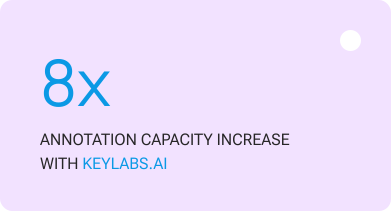
8x
increase in
operational capacity

Scalability limitations were fully resolved through migration to Keylabs.ai. Post-migration, over 50 operators were able to work concurrently without performance degradation, resulting in an 8x increase in operational capacity.

Keylabs’ architecture ensured readiness to scale at any point, enabling the customer to respond to changing data volumes and project phases without workflow disruption.

Labeling speed was improved using Keylabs.ai platform features. Tools such as macroshots enabled annotators to instantly locate and preview specific object classes (e.g., traffic signs), reducing instruction-related errors and increasing throughput.

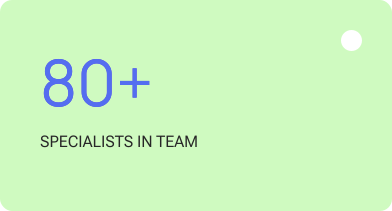
80+
trained
specialists
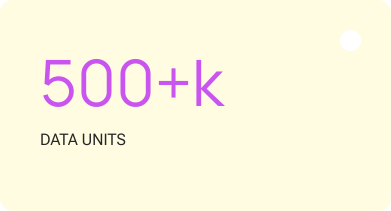
500k+
data
units

Throughout the engagement, strict deadlines were consistently met, with a team of over 80 trained specialists working across multiple annotation phases. In total, more than 500,000 data units were processed with high precision, supporting the ongoing development of ADAS and traffic detection systems for real-world deployment.

Reviews
on

down-line
high perfomer
high perfomer emea
leader
star
star
star
star
star

"Delivering Quality and Excellence"

The upside of working with Keymakr is their strategy to annotations. You are given a sample of work to correct before they begin on the big batches. This saves all parties time and...

star
star
star
star
star

"Great service, fair price"

Ability to accommodate different and not consistent workflows.
Ability to scale up as well as scale down.
All the data was in the custom format that...

star
star
star
star
star

"Awesome Labeling for ML"

I have worked with Keymakr for about 2 years on several segmentation tasks.
They always provide excellent edge alignment, consistency, and speed...

More
cases

down-line

MusicTech

Providing consensus-based media monitoring to help SoundAware protect the intellectual property rights of creators

Robotics

Helping Cognex with high-quality OCR and object detection datasets for industrial automation

AgriTech

How Keymakr supported Bluewhite in advancing real-world autonomy