
















RUKOPYS Ukrainian handwritten text dataset case study header

How Keymakr supported
the creation of RUKOPYS,
Ukraine's first open
handwritten text dataset

Document AI for public services

Project for:
Services:
Overview:
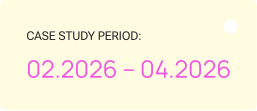
Case study period 02.2026 to 04.2026
Team of up to 10 specialists
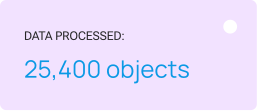
25,400 objects processed
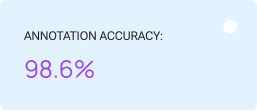
98.6% annotation accuracy

Intro

The project emerged as part of a government initiative to digitize document processes in Ukraine. One of the practical drivers was ePermit, a digital service within the Diia portal. While working with this service, it became clear that a significant share of documents still exists as scans, photos, or handwritten fragments, which are difficult to process automatically with high quality.

For such scenarios, simply digitizing a document is not enough. An AI system needs to recognize text, understand its structure, and work with different types of real-world documents: modern and archival, clear and low-quality, printed and handwritten.

Using external state-of-the-art models is not always possible in government processes, especially when documents contain personal data. This created a need for models that can be deployed locally in a controlled environment, as well as a high-quality open dataset of Ukrainian handwritten text for training them.

The initiative brought together government, educational, and technology partners: Ministry of Economy, Environment, and Agriculture of Ukraine, the AI community AI HOUSE, Ukrainian Catholic University, and the Ministry of Digital Transformation of Ukraine. RUKOPYS became the foundation for Handwritten to Data, an AI challenge focused on recognizing Ukrainian handwritten documents. During the competition, participants trained various models on the prepared dataset, competing to achieve the best recognition performance on real handwritten documents.

Keymakr joined RUKOPYS as an annotation partner. The team's task was to help transform diverse handwritten materials into a structured dataset suitable for training AI models and further use in research, education, and document digitization workflows.

RUKOPYS: https://huggingface.co/datasets/UkrainianCatholicUniversity/rukopys

The challenge

RUKOPYS was intended to become the first open dataset of Ukrainian handwritten text. This meant that the team was not working on a standard HTR/OCR task alone, but on building a full system for interpreting unstructured documents: different handwriting styles, historical spelling variations, low-quality images, and a large number of ambiguous cases that required human contextual understanding.

Together with the project team, Keymakr helped shape the methodology for working with Ukrainian handwriting and defined how to interpret complex fragments, handle uneven or tilted lines, separate text blocks, and handle partially illegible words and non-standard content placement on the page.

The data was also highly diverse. The team worked with archival materials, school and university assignments, and dictations. Each source had its own specifics: different page structures, scan quality, vocabulary, readability levels, and handwriting complexity.

Additionally, the project had a strict timeline, as the dataset was being prepared for the launch of the Handwritten to Data AI Challenge. Keymakr needed to build a process that could quickly scale data processing, deliver completed batches on schedule, incorporate feedback, and maintain the quality and accuracy of the annotation.

RUKOPYS annotation pipeline from raw documents through AI pre-annotation to manual validation
The solution

The Keymakr team joined RUKOPYS at the stage of manual annotation and data validation. By that point, the documents had already undergone AI pre-annotation: the system automatically identified regions on the page and attempted to recognize the text within each. Keymakr's task was to validate this annotation, correct errors, and bring the data to a quality level suitable for model training.

As part of the project, the Keymakr team annotated and validated 25,400 objects, including individual text lines, short handwritten fragments, formulas, tables, graphic elements, margin notes, and other document regions.

Correction of page structure and classification of different content types

One of the main tasks was validating bounding boxes – regions that the AI system automatically created for individual lines of text. In real-world documents, the model could make mistakes: missing certain lines, merging two lines into a single bounding box, incorrectly defining text boundaries, or including unrelated elements in a region. For this reason, the team manually corrected the page structure.

Another separate task was content type classification. Each region was assigned a class: handwritten text, printed text, formula, table, graphic element, and so on. This was important for further model training, since different types of content require different processing logic. For example, inline formulas within handwritten text were not separated into individual formula blocks but remained part of the text region, whereas complex mathematical structures were moved to a separate backlog for additional processing.

Line-level bounding boxes and content classes validated on an archival letter in Keylabs
Transcription without “correcting” the author

After that came the stage of transcription and manual text verification. The team checked whether the recognized text matched the original writing, including the author's mistakes, non-standard spelling, or inconsistent character forms. One of the core principles was not to “correct” the text visible in the image, but to preserve its original form as accurately as possible.

If certain words were illegible, special markers such as [illegible] were used. For completely unreadable regions, the [legibility=illegible] attribute was applied, and the transcription field was left empty.

The deeper the team got into the task, the more the instructions, QA processes, and logic for working with specific document types were refined.

In practice, the pipeline went through the following cycle: AI pre-annotation – manual review – error analysis – rule refinement – process update. Thanks to this iterative approach, the average annotation accuracy reached 98.6%, despite the diversity of sources, the complexity of handwriting styles, and the large number of ambiguous cases.

Handwritten text transcription and verification of a university exam sheet in Keylabs

To prepare the data in time for the launch of the Handwritten to Data AI Challenge, Keymakr gradually scaled up the team, and at its peak, the team grew to 10 specialists. This made it possible to maintain a stable annotation pace, regularly deliver completed batches, and quickly incorporate feedback within clear deadlines.

Developing a methodology for different data sources

One of the main challenges of working on RUKOPYS was the extraordinary diversity of the documents themselves.

  • Materials from the State Archives became the most complex source of all. This was primarily due to archaic handwriting styles and document structures that are unusual for modern users. The materials spanned more than 100 years and often appeared on sheets with highly atypical colors and textures. In addition, a significant share of the texts was written not with pens in the modern sense, but with quills. As a result, the letters had different thickness, irregularity, and writing dynamics. The structure of the documents themselves added another layer of complexity. Sometimes the material was continuous text in the format of a letter, while in other cases it was a postcard with many stamps, seals, and separate text blocks placed in different parts of the page.
Archival letters spanning more than 100 years annotated for the RUKOPYS dataset
  • The structure of school manuscripts depended heavily on the subject. In Ukrainian language assignments, the content was mostly continuous text, while mathematics introduced tables and special symbols. Sometimes the document was a contour map with city labels or mineral resource markings. In other cases, it was a chemical formula or molecular structure, where elements were connected through a complex system of lines and bonds. There were many such situations, and the team had to gradually develop separate rules and exceptions for them.
School manuscripts with mixed content of text, tables and symbols annotated for RUKOPYS
  • Student assignments also had their own specific features. At universities, exam papers are written on A4 sheets. In these documents, text lines often lose clear horizontal alignment: a student may start writing along one axis and finish the line with an upward or downward shift. In such cases, the AI model often mistakenly merged fragments from different lines into a single region or shifted the boundaries of bounding boxes. That is why, even after automatic pre-annotation, manual human review remained essential.
University exam sheets with uneven handwritten lines reviewed after AI pre-annotation
  • National dictations added another important type of source to the dataset. Unlike school assignments with mixed visual structures, dictations were mostly continuous handwritten text, which made them valuable for training models on natural writing flow, spelling variations, punctuation, and line-by-line transcription. At the same time, they still introduced challenges related to individual handwriting styles, corrections, uneven spacing, and occasional low legibility.
National dictation pages of continuous handwritten text annotated for RUKOPYS

First training results on the dataset

After preparation, RUKOPYS became the foundation for Handwritten to Data, an AI challenge in which participants used the dataset to train, test, and improve their models, competing to achieve the best recognition quality on real handwritten documents.

More than 870 participants joined the challenge, forming 198 teams and submitting over 6,800 model versions on Kaggle. The top 10 teams reached the final and presented their solutions to the jury. This made Handwritten to Data one of the largest AI competitions in Ukraine dedicated to building solutions for the digitalization of government services.

The winning team's solution demonstrated the highest accuracy on a closed set of real documents, including materials from the Mriia platform, the State Judicial Administration, the State Archival Service, and other partners.

The practical outcome of the challenge went beyond the competition itself. The winning team's solution is planned to be integrated into government services, including updating the recognition model in ePermit, digitizing archival collections together with the State Archives, automatically checking homework in Mriia, and other use cases.

Handwritten to Data AI Challenge final event with participating teams

Results

As part of the project, Keymakr helped transform diverse handwritten materials into structured data suitable for training models to recognize Ukrainian handwritten text. The work included AI pre-annotation validation, document structure correction, transcription, content classification, QA, and the development of a stable data preparation process within the challenge deadlines.

Methodology for working with Ukrainian handwritten text
Together with the RUKOPYS team, Keymakr helped develop an approach to interpreting Ukrainian handwritten documents. This included rules for handling different handwriting styles, historical spelling variations, low-quality scans, uneven text lines, mixed content types, and ambiguous cases requiring human contextual understanding.
25,400 annotated and validated objects
These included individual text lines, short handwritten fragments, formulas, diagrams, images, margin notes, and other page regions. As a result, the dataset could support a broader task of document understanding.
98.6% average annotation accuracy
The project maintained a high level of accuracy despite the complexity of handwritten text and archival documents, the low quality of some scans, and ambiguous cases requiring manual interpretation.
Contribution to the first open dataset of Ukrainian handwritten text
The prepared data became part of RUKOPYS, the first open dataset of Ukrainian handwritten text, which Handwritten to Data participants used to train, test, and improve models for recognizing real documents.
"Preparing datasets such as RUKOPYS is extremely complex and has historically required significant resources. That is why we were looking for support to ensure the high-quality implementation of this project. The Keymakr team, a company with extensive experience in preparing data for CV and LLM models, joined the labeling and validation processes. This partnership became an important support for us, as implementing a project of this scale solely within a government structure would have been much more challenging in terms of time and resources. Thank you to the entire team for becoming part of this project!"
Quote icon

Dmytro Voitekh, AI Tech Lead at Mriia and Lead of RUKOPYS

"It was an honor for our team to contribute to this unique project, supporting both the preservation of Ukraine's cultural heritage and the advancement of AI. We sincerely thank AI House, the entire project team, and Dmytro Voitekh for their trust, professionalism, and excellent collaboration. We are proud to have contributed to the dataset behind this world-class Ukrainian handwritten text recognition challenge and believe initiatives like this create lasting value for both young researchers and computer vision technologies as a whole in Ukraine."
Quote icon

Gleb Zakharov, Keymakr PM

Reviews
on

down-line
g2
star
star
star
star
star

"Delivering Quality and Excellence"

The upside of working with Keymakr is their strategy to annotations. You are given a sample of work to correct before they begin on the big batches. This saves all parties time and...

star
star
star
star
star

"Great service, fair price"

Ability to accommodate different and not consistent workflows.
Ability to scale up as well as scale down.
All the data was in the custom format that...

star
star
star
star
star

"Awesome Labeling for ML"

I have worked with Keymakr for about 2 years on several segmentation tasks.
They always provide excellent edge alignment, consistency, and speed...

More
cases

down-line
Confidential client icon

Automotive

Delivering scalable traffic detection data for a major automotive company

SoundAware logo

MusicTech

Providing consensus-based media monitoring to help SoundAware protect the intellectual property rights of creators

Cognex logo

Robotics

Helping Cognex with high-quality OCR and object detection datasets for industrial automation