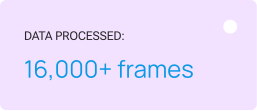
The Keymakr team processed more than 16,000 frames, creating detailed labels of industrial environments to support deepsafety's perception models.
A key objective of the project was enabling AI systems to distinguish permanent infrastructure from temporary objects that may change from scene to scene. To achieve this, the workflow relied on detailed bitmap masks, class-specific annotation rules, and a predefined hierarchy governing relationships between different object categories.
Work on each image began by establishing the scene's structural foundation. The Keymakr team first segmented the floor and ceiling to create the geometric framework of the environment. This process required manually excluding all unrelated objects located on these surfaces, including cables, boxes, tools, equipment, and other items that did not belong to the underlying structure. In many cases, these objects contained numerous small details, openings, and gaps, making the segmentation process highly labor-intensive. Once the structural elements were completed, experts annotated racks, storage containers, and other infrastructure components according to the predefined object hierarchy.
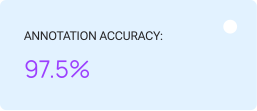
To accelerate production, the team selectively used ML-assisted pre-annotation for segmenting humans in simpler scenes. However, due to strict accuracy requirements, no automatically generated mask was accepted without manual review. The team refined silhouette boundaries, fixed errors, and handled more complex scenarios involving reflections on different surfaces.
Throughout the project, Keymakr worked closely with deepsafety to continuously adjust annotation logic and optimize the most resource-intensive workflows. The teams evaluated how different object categories influenced model training and adjusted annotation requirements where possible without compromising dataset quality. This collaborative approach helped preserve the level of detail required for industrial scene understanding and improve annotation efficiency across large volumes of data.
The project also required a high degree of operational flexibility. To meet demanding delivery timelines, the team could scale from 10 up to 50 specialists depending on project volume and deadlines.