Chef Robotics food assembly automation case study header

How Keymakr supported
Chef Robotics in advancing
Physical AI systems for
food assembly automation

Physical AI for food automation

Company:
Services:
Overview:
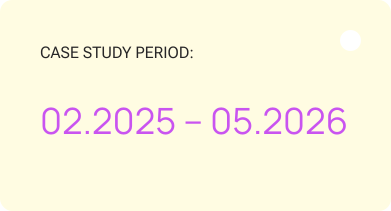
2 months case study period
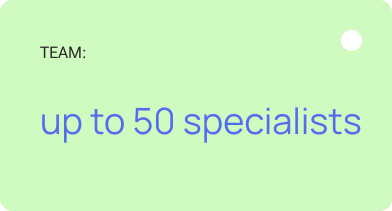
Up to 50 specialists and 2.5M video frames processed

Intro

Chef Robotics is a company developing Physical AI systems for automating food manufacturing and meal assembly operations. The company focuses on building adaptable systems capable of handling real-world food variability, the main challenge preventing traditional automation from scaling effectively in food production.

At the center of Chef Robotics' technology stack is ChefOS, the company's proprietary AI-enabled robotics system designed to continuously improve robotic performance through operational data and machine learning. Unlike conventional rule-based automation, ChefOS enables robotic systems to adapt to changing production conditions, ingredient appearance, tray configurations, food positioning, and different meal assembly workflows in real time. The model supports a broad range of applications, including prepared meals, airline catering, co-manufacturing, and medically tailored meal production. ChefOS systems are already deployed across food manufacturing facilities in the US, Canada, and Europe.

Transparent containers and insert trays with overlapping boundaries during annotation

To achieve stable robotic manipulation in these environments, the model must reliably operate with a large variety of containers, ingredients, insert trays, sauce packets, and graspable objects that constantly vary in shape, positioning, texture, and appearance. This requirement served as the foundation for the collaboration between Chef Robotics and Keymakr, in which the Keymakr team prepared annotations for robotics perception and meal-assembly workflows.

Sauce packets annotated with oriented bounding boxes for robotic grasping

The challenge

Although the individual project batches were relatively small, the overall pipeline involved several technical challenges due to the large number of small edge cases and the high variability of objects. Separate instructions were created for each project type, and dedicated operator training sessions were conducted to ensure consistent annotation quality.

  • One of the main challenges was the diversity of containers, insert trays, and ingredients. Over time, Chef Robotics introduced more complex shapes with varying geometries, sizes, and container placements. Additional complexity arose from scenarios where the system had to determine whether it could be successfully picked up by the robotic arm.
  • Another challenge involved working with transparent materials. Both the containers and the insert trays were made of transparent plastic, resulting in object boundaries often visually blending into one another.
  • The project also required handling complex, partially occluded objects. Some containers or insert trays could be partially blocked by the robotic arm, sauce packets, or other elements of the production line. At the same time, annotations were performed at different visibility thresholds, requiring regular updates to annotation rules and QA approaches.
  • A separate category of complexity involved ingredient segmentation projects. These tasks became challenging when ingredients had similar colors or textures, making changes from frame to frame imperceptible.
Transparent containers and insert trays with overlapping boundaries during annotation
The solution
Flexible annotation workflow

The entire workflow was built around a flexible, iterative model using small batches, which were regularly delivered by Chef Robotics as the requirements of their CV models evolved. The Keymakr team worked directly within the Keylabs platform, which allowed the pipeline to be quickly adapted for new task types and enabled separate workflows for different subprojects.

At the initial stage, the projects focused on annotating containers and inserting trays using oriented bounding boxes. Operators defined the object boundaries and the precise angle of the object inside the container. Over time, the pipeline became more complex, expanding into segmentation tasks for ingredients, sauces, and objects that the robotic system needed to detect, grasp, or recognize during operation.

In many cases, the boundaries of the insert trays visually blended into the container s surface, further complicated by motion blur from the robotic arm and the specifics of the installed camera system. To accurately annotate transparent-on-transparent objects, operators used multiple zoom levels and continually compared object shapes against Chef Robotic’s reference materials.

Ingredients annotated with bitmap segmentation on a robotic perception tray

One of the key solutions was the development of a custom pre-annotation approach for inserting trays inside containers. Before annotation began, the system automatically placed bounding boxes with predefined sizes and proportions, while experts manually repositioned and rotated them to the correct angle and adjusted them based on the actual placement of the insert tray in the image.

This workflow also changed the approach to partially occluded objects. Initially, annotation was performed only on the visible portion of the object, but later operators began "reconstructing" the hidden boundaries behind obstructions. This was necessary to keep all bounding boxes consistent in size and proportions so the model would not lose understanding of identical insert tray types due to partial occlusions or deformation of the visible object area.

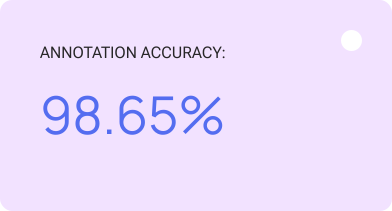
The visibility threshold also evolved during the project. In many situations, determining whether an object should still be annotated remained subjective and required additional QA verification. Despite the data's complexity and high variability, the project maintained an average annotation accuracy of 98.65%.

Segmentation stage

For segmentation projects, the team created separate instructions for nearly every object type. For example, in sauce-packet tasks, operators had to identify only the objects the robotic arm could physically grasp. In some cases, annotation was performed only for a specific part of the object, for example, the upper visible area that the system could reliably recognize and use for grasping operations.

Before and after frame pair used to segment a newly added salad ingredient

In certain scenarios, the model needed to identify the specific ingredient added to the scene after a particular robotic arm action. To accomplish this, "before" and "after" frame pairs were used, requiring the team to identify the newly added element and precisely define its boundaries. Operators continuously compared the two frames side by side to separate the newly added ingredient from existing food components, even when the ingredients had very similar colors or textures.

The project required a high degree of operational flexibility. Particularly important batches needed to be delivered within a single working day. Depending on workload requirements, the team scaled from 2 to 10 operators without rebuilding the pipeline.

Before and after frame pair used to segment a newly added salad ingredient

Results

The collaboration between Keymakr and Chef Robotics demonstrated how iterative data workflows and custom annotation solutions can support the development of robotics systems in real-world production environments.

Custom pre-annotation system for insert trays
The automatic pre-annotation mechanism developed by Keymakr made it possible to standardize oriented bounding boxes for different insert tray types, reduce annotation variability, and maintain dataset consistency for robotics models.
98.65% average annotation accuracy
The iterative workflow, continuous QA verification, and separate instruction pipelines for different object types enabled the team to maintain a stable and reproducible level of annotation quality throughout the project.
Flexible operational model for urgent robotics batches
Depending on workload requirements, the team could scale from 2 to 10 operators and complete urgent batches within a single working day without rebuilding the pipeline or compromising quality.
High-variability robotics datasets
The project covered a wide range of containers, insert trays, ingredients, graspable objects, and partially occluded elements, allowing for building Computer Vision datasets better suited for a dynamic food manufacturing environment.
"Keymakr's ability to handle the complexity and variability of our food production data was critical to advancing our Physical AI systems. Their iterative annotation workflows, custom pre-annotation tooling, and consistently high accuracy gave us the reliable training data needed to improve ChefOS performance across real-world deployment environments. The collaboration was seamless, and the quality of the datasets directly translated into more robust robotic perception in our production facilities."
Quote icon

Gaurav Kuppa, Perception Engineer at Chef Robotics

"Working with Chef Robotics has been an incredibly rewarding experience for our team. Beyond the technical side of the project, it’s exciting to contribute to something so tangible seeing how the datasets we prepare directly support real-world robotic systems. The Chef Robotics team was collaborative and responsive throughout the process, and projects like this are a great reminder of how closely high-quality data and Physical AI development are connected."
Quote icon

Oksana Charkina, Keymakr PM

Reviews
on

down-line
g2
star
star
star
star
star

"Delivering Quality and Excellence"

The upside of working with Keymakr is their strategy to annotations. You are given a sample of work to correct before they begin on the big batches. This saves all parties time and...

star
star
star
star
star

"Great service, fair price"

Ability to accommodate different and not consistent workflows.
Ability to scale up as well as scale down.
All the data was in the custom format that...

star
star
star
star
star

"Awesome Labeling for ML"

I have worked with Keymakr for about 2 years on several segmentation tasks.
They always provide excellent edge alignment, consistency, and speed...

More
cases

down-line
Confidential client icon

Automotive

Delivering scalable traffic detection data for a major automotive company

SoundAware logo

MusicTech

Providing consensus-based media monitoring to help SoundAware protect the intellectual property rights of creators

Cognex logo

Robotics

Helping Cognex with high-quality OCR and object detection datasets for industrial automation