The Hidden Complexity of Game Data Annotation
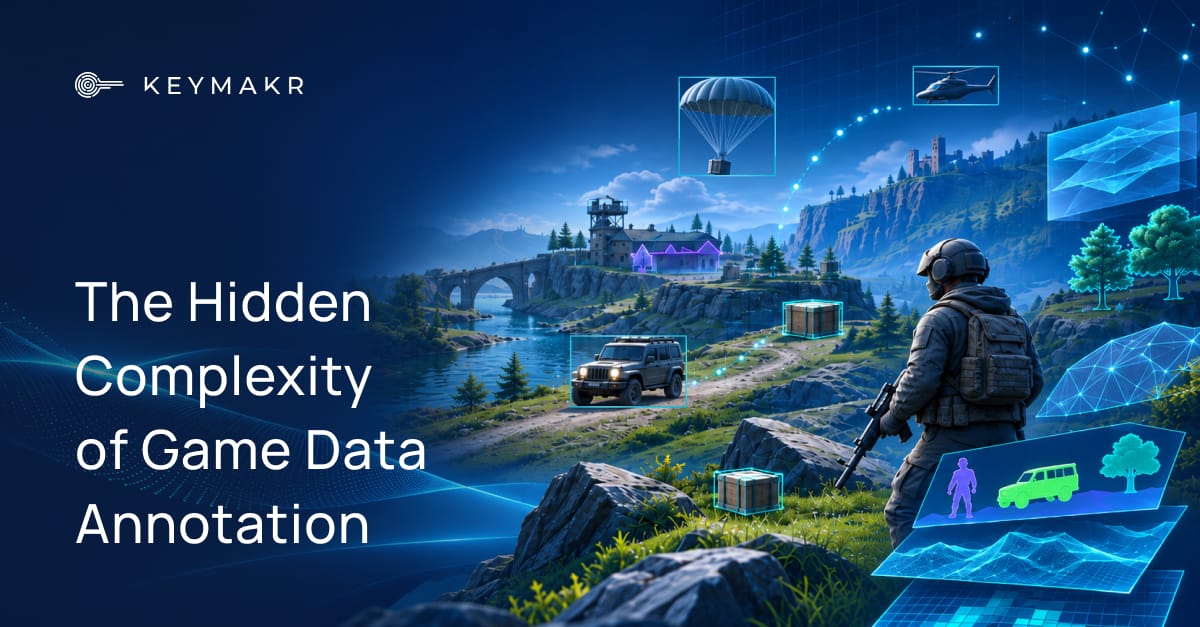
Artificial intelligence is already quite good at recognizing game characters, objects, movements, and events. Yet seeing what happens on screen does not mean truly understanding the game itself. To learn how to interact with a virtual environment, an AI model must grasp how game situations evolve, which actions lead to specific outcomes, and how the game state changes in response to the player's decisions.
Most modern systems currently train on records of actual gameplay. Because such systems operate precisely with sequences of observations and actions, even a minor timestamp error can distort the meaning of an entire game situation.
Quick Take
- Game AI must understand actions, events, and changes in game states.
- Gameplay annotation combines object tracking, action labeling, event segmentation, and temporal synchronization.
- Even highly accurate frame-level labels can create unreliable training data when timestamps and event boundaries are inconsistent.
- Temporal annotation is essential for training autonomous agents, adaptive NPCs, player behavior models, and AI-powered testing systems.
- Sequence-level quality assurance helps detect inconsistencies that conventional frame-by-frame checks can miss.

What Exactly Needs to Be Annotated in Game Sequences?
A single screenshot can show a model that a character is standing near a door, an enemy is approaching, and the health bar is nearly depleted. But it cannot explain what happened moments before and how that influenced the game.
Thus, unlike traditional image markup, gameplay annotation frequently involves working with multiple interconnected layers of information. The specific schema depends on the model's purpose, but typically includes the following elements:
- Game Objects and Entities. Characters, enemies, weapons, vehicles, interactive items, environmental elements, and user interfaces must be identified and tracked. Depending on the task, bounding boxes, polygons, segmentation masks, or keypoints are used for this.
- Player Actions. It is crucial to capture what the player is doing: moving, jumping, attacking, blocking, interacting with items, switching weapons, or navigating the game world. In some projects, this is supplemented with keyboard presses, mouse movements, and controller commands with corresponding timestamps.
- Events and Their Boundaries. The start and end of every action or event must be defined. An enemy attack, a hit, character death, acquiring an item, or transitioning to a new level can be distinct annotated events.
- Game States. The model may require information on whether a character is idle, moving, attacking, stunned, injured, or defeated. Metrics such as health levels, available resources, active quests, inventory, and current mission stage can also be factored in.
- Outcomes and Causal Relationships. What happened after a specific action? Did the player manage to open a door, activate an ability, defeat an opponent, or complete a quest? The link between actions and their consequences helps the model learn how the environment reacts to its decisions.
These layers do not exist in isolation: annotating an attack may require identifying the character, marking the start and end of movement, tracking the target, and determining whether the interaction concluded with a hit. When all these elements align consistently, the dataset gives the model a much more comprehensive understanding of the gameplay process.
Why Can Temporal Consistency Determine Training Quality?
One of the least obvious yet previously mentioned challenges in annotating sequential data is the accuracy of timestamps. A frame might be annotated with absolute perfection, yet tied to the wrong moment of the in-game action. At first glance, this is a minor technical error, but it is capable of creating contradictory training examples for the model.
If in one record a character is still attacking, while in another the exact same moment is already labeled as post-attack recovery, the model receives contradictory information. This happens when annotators define the end of an animation, the moment of a successful interaction, or a character's state transition differently.
Michael Seldin, CTO of Keymakr, says about this problem:
“Even with annotation accuracy above 98%, getting sequential data right is a different challenge. We've seen how poor synchronization of action timestamps, event boundaries, and game-state transitions can lead to temporal inconsistencies accounting for up to 15% of issues flagged during quality checks. Individual frames may be labeled correctly, but a small timing mismatch can still create conflicting training examples of the same behavior. That's what makes sequential models so sensitive to temporal errors: they need consistent context across observations, not just accurate labels.”
This is a vital nuance for game AI developers. Traditional annotation accuracy metrics may show wonderful results, but do not necessarily reflect how logically consistent the entire sequence is.
Where Does Temporal Annotation Matter Most in Game Dev?
The importance of synchronized game data is especially evident across different artificial intelligence application domains.
How to Build a Reliable Game Data Annotation Process?
A team must understand what the model is supposed to learn and translate that objective into a clear, consistent annotation schema.
1. Define Target Actions and Game States.First, consider the future model's purpose. An agent designed to beat a platformer will require a different label set than a system analyzing multiplayer combat or NPC interaction.
Determine in advance which entities, actions, events, states, and outcomes matter for training. Avoid adding labels that do not help achieve the goal, as they will only burden the model with redundant information.
2. Establish Clear Temporal Boundaries.Annotators must receive clear rules for determining the start and end of actions and events. For example, when exactly does an attack begin: from the first animation frame, the moment the weapon moves, or the instant a strike can deal damage?
Depending on the task, different valid options may exist. The key is to choose a unified methodology and apply it consistently across the entire dataset.
3. Synchronize Different Data Sources.Gameplay video recordings can be accompanied by button press data, mouse movements, telemetry, event logs, and other game state details. All these sources must be anchored to a shared timeline.
It is crucial to account for varying frame rates, dropped frames, processing lags, and timestamp format differences. Otherwise, information about the exact same interaction may look as though it pertains to entirely different moments.
4. Use AI-Assisted Annotation Where Appropriate.Computer vision and multimodal AI tools can help identify objects, track characters, suggest action labels, and determine probable event boundaries. This reduces repetitive manual labor, especially in large datasets.
However, automated predictions of rapid animations, visual effects, occluded characters, and unusual gameplay situations can lead to misinterpretation. Therefore, human annotators remain essential for verifying ambiguous cases, correcting predictions, and ensuring labels match the true interaction content.
5. Implement Sequence-Level Quality Assurance.Carefully verify timestamp synchronization, event boundary sequencing, and the logical flow of game state transitions. For example, a character should not be marked as defeated prior to the event that caused their defeat, unless the annotation schema dictates a separate early state transition. Reviewing entire video segments and action sequences helps uncover inconsistencies that remain invisible during frame-by-frame audits.
FAQ
How does game genre dictate data labeling rules?
Every genre has its own specifics, so there is no universal annotation template – everything comes down to core mechanics. For a first-person shooter, it is essential to recognize aiming, shot direction, ballistics, and projectile trajectories. In an RPG, completely different things come to the fore: quest trees, dialogue branches, inventory management, and NPC interaction triggers. In strategies, the focus shifts from the micro-movements of a single hero to the state of the entire map – controlling dozens of units, resource harvesting, and macro-decisions. That is precisely why labeling guidelines must be built for specific tasks: which exact features or behaviors you want to extract from the game and feed into the model.
What should be done with rare and non-standard game situations?
"Edge cases" are the most painful point for AI. These can be bizarre combinations of player actions, physics bugs, an unpredictable NPC behavioral "glitch", or a non-standard combat tactic that is hard to catch during standard sessions.
To teach the model not to break on such moments, developers use three main techniques:
- Targeted collection: purposeful hunting for in-game anomalies;
- Synthetic data: artificial modeling of rare scenarios inside the engine;
- Oversampling: artificially increasing the share of such events in the dataset so the model sees them more frequently during training.
How do annotation errors affect AI generalization across different games?
Even if the mechanics of two games are nearly identical, a model from one game rarely scales to another "out of the box". Differences in visuals, animations, physics, keybindings, and interaction logic become obstacles. If you add sloppy or inconsistent labeling to this, the AI begins to confuse things and anchor correct actions to completely false visual patterns. To prevent this, you need maximum diversity in training samples and clear label semantics.
Who should define gameplay labels: game designers or AI engineers?
Balance and tight collaboration are needed here, because on their own, both sides will slip up. Game designers know how mechanics work, which actions are meaningful, and how different game states relate to one another. AI engineers understand what information the model needs to learn and how annotation structures impact training. Without collaboration, labels may be technically consistent yet fail to reflect actual gameplay logic, or they may utilize game-specific terminology that models struggle to interpret. The most effective approach involves co-developing annotation guidelines using well-defined gameplay concepts that also meet the model's technical requirements.
What is the difference between game telemetry and annotated gameplay?
Telemetry consists of dry, "raw" logs that the game writes automatically: the player pressed this button, the character dealt 50 damage, the enemy's HP dropped. It records facts, but does not explain their context. Annotated gameplay gives it context and meaning: decoding that this action was part of a combo attack, targeted at a specific boss in counter-attack mode. Telemetry shows "what happened", while labeling shows "what it meant in the context of the game".