Using Vision AI to Optimize Warehouse Flow
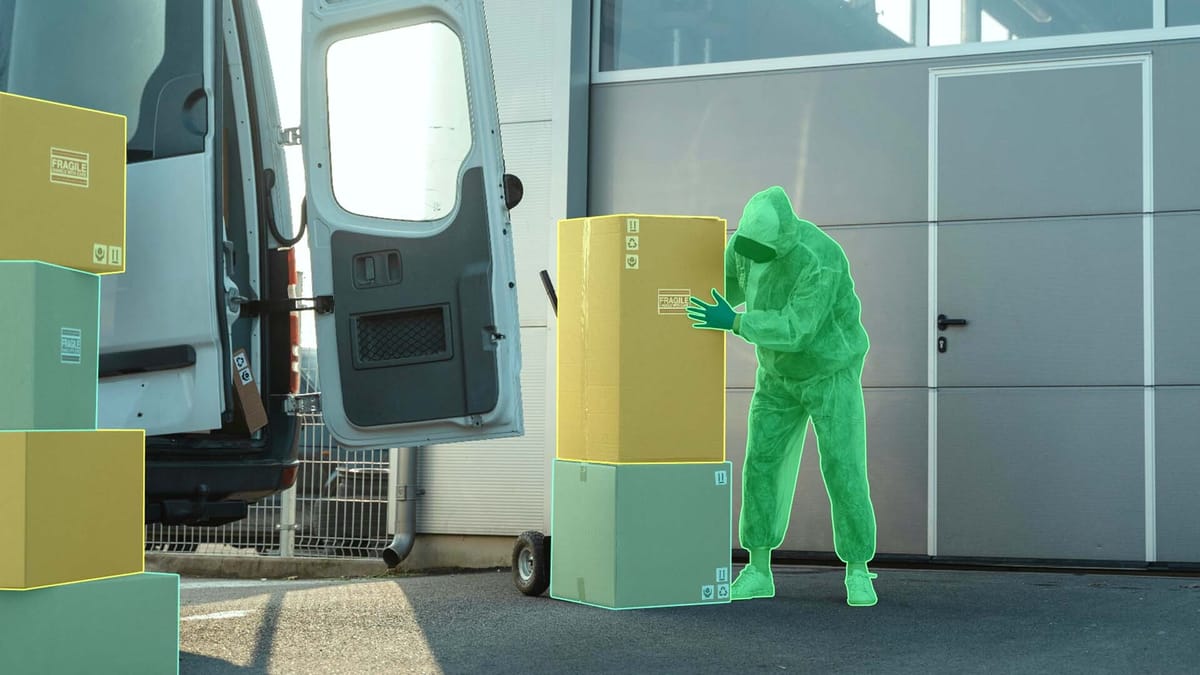
Modern warehouses process hundreds of thousands of items daily, which are constantly in motion, and the demand for speed is only increasing. Although many of them use intelligent systems, such as scanners, robots, and management software, these tools do not see the full context. They know that a product should be in a specific place, but they do not see what is really happening in the warehouse.
Simply put, movement in a large warehouse is often a "black box." Management only sees the result but does not see the specific causes of delays or inefficient personnel routes. Traditional methods only provide isolated data points, not the whole picture. This is where vision AI comes in handy.
It uses ordinary cameras installed in the warehouse to convert the video stream into measurable metrics. This is akin to creating a "visual analytics layer" that understands what, where, and when things are happening. Vision AI makes the workflow completely visible and helps management make decisions based on real data, not assumptions.
Quick Take
- The automated system converts cameras into scanners, enabling instantaneous inventory updates and reducing the need for manual scanning.
- Vision AI acts as a constant supervisor, automatically detecting violations and sending real-time alerts.
- To train the AI, video data annotation is necessary for object classification.
- Edge AI is used for instantaneous reaction and minimizing delays.

Applications of Vision AI in the Warehouse
Vision AI uses cameras to create "smart eyes" for the entire warehouse. This helps automate control and increase efficiency. It continuously monitors the movement of goods and personnel.
Its task is to detect exactly where the process is slowing down. If congestion or a queue begins in the packing area, AI records it. Thus, it helps management quickly eliminate "bottlenecks" before they lead to a significant delay.
Optimizing Equipment Routes
This application directly improves the efficiency of robotics in logistics. The system sees all forklifts, operators, and autonomous machines.
If Vision AI sees that two forklifts are driving towards each other and might create a "jam," it can correct their movement in real time. This ensures the minimization of downtime and reduces the time required for order picking.
Loading and Unloading Control
Work quality is automatically checked, without human intervention. Computer vision helps determine if a pallet is correctly positioned. For example, AI can see if a box extends beyond the edges or if the vehicle is not fully loaded.
This ensures the reduction of cargo damage during transport and increases the efficiency of space utilization in trucks.
Real Time Inventory
AI turns cameras into scanners to create a smart inventory system. It can recognize labels, barcodes, or even the shape of boxes on the shelves. This allows for instantaneous updating of inventory data.
The need for manual scanning and physical counting is reduced. The warehouse always knows how much product is available, which improves the accuracy of stock control.
Personnel Safety
Vision AI helps protect employees by acting as a constant safety supervisor.
The system can automatically detect dangerous actions, such as whether an employee is wearing a protective helmet in the forklift work area or whether they are standing too close to moving machines. Alerts are sent immediately, which helps prevent accidents and guarantees adherence to safety rules.
Video Data Annotation for Vision AI
Artificial intelligence of vision cannot simply "start" to understand a warehouse. For the system to distinguish between a pallet, a forklift, or an employee, it must first be trained, a process known as video data annotation.
Object Recognition and Classification
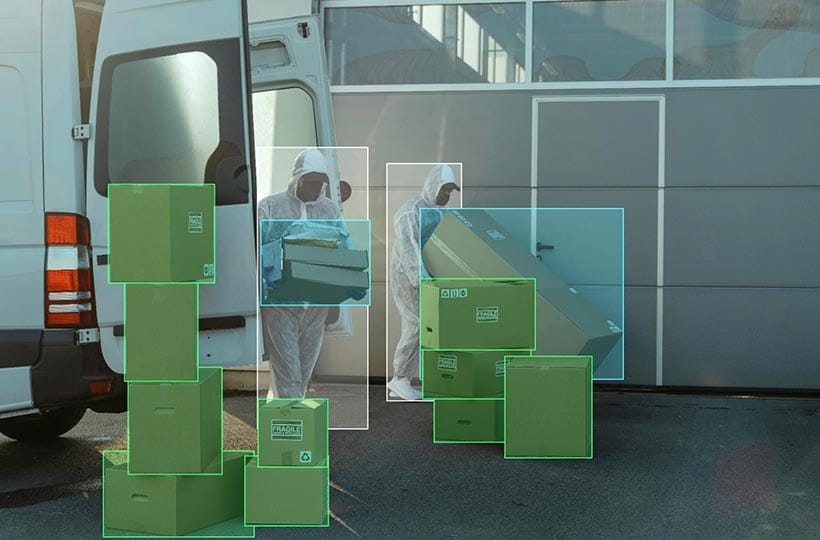
The most important annotation task is to teach the model to recognize and label objects. Data labeling specialists take video recordings from the warehouse and literally draw marks on them. For this, they use graphic tools to highlight each object:
- Bounding Boxes. Encircling the object with a simple rectangle, for example, around a forklift. This gives AI a general idea of the object's location.
- Precise Outlining. In more complex cases, specialists very accurately outline the object's contour, for example, an employee or a specific zone.
Clear labeling of all elements is the foundation. If the annotator incorrectly labels a forklift, AI will then make the same mistake.
Movement and Behavior Annotation
The next step is to teach AI to understand not only what it sees but also what these objects are doing.
- Tracking. Specialists mark the same object frame by frame. This allows AI to track its full trajectory of movement through the warehouse. Thanks to this, we can later detect inefficient routes.
- Action Labeling. The model must understand the context. For example, when an employee lifts a box, the annotator labels this specific action, forming a connection. This teaches AI to distinguish packing from simple movement.
The Foundation of Quality
The success of the entire vision AI system depends entirely on the quality, quantity, and consistency of the annotated video data. This is because the labeled data is the only "textbook" from which AI learns. If the labeling rules are unclear or the data contains errors, the final analysis of the warehouse will be inaccurate. Thus, quality annotation is the foundation for creating a smart, reliable warehouse.
Ensuring Safety and Quality with Vision AI
Vision AI in the warehouse not only optimizes the movement of goods but also serves as an important tool for safety and quality control. It constantly monitors processes and helps prevent problems before they arise.
Safety Rules Control
The model automatically identifies whether personnel are wearing all necessary personal protective equipment in hazardous areas where heavy machinery is in operation. The system can also detect potentially hazardous forklift maneuvers or record instances when employees are standing too close to moving machines.
This allows for the automatic sending of real-time alerts to operators or management, which helps prevent accidents and simplifies the formation of clear violation reports.
Packing and Shipment Quality Control
Vision AI helps minimize errors caused by the human factor, ensuring the quality of order picking. It checks whether the product is correctly placed in the box and whether the quantity and type of product match the original order.
At the same time, the system can check whether the box is undamaged, whether the product protrudes beyond the edges of the pallet, and whether the packaging meets standards for safe transport. Such automatic control significantly minimizes product returns and complaints from end customers, which often arise due to missed or incorrectly packed items.
Technical Implementation and Future
For Vision AI to work effectively in the warehouse, it requires modern technical support. This also paves the way for a fully autonomous warehouse.
Technical Infrastructure
A key element is Edge AI. Instead of sending large video files for analysis to a central cloud, data processing occurs directly on-site, on devices near the cameras.
This ensures an instantaneous reaction and significantly reduces delays. For example, the system immediately alerts about safety violations. The warehouse receives analytics "here and now."
Reporting and Actions
The system converts raw video into understandable data that requires immediate action. Thus, it creates clear dashboards where video data is displayed as heatmaps or flow maps.
These maps show management exactly where congestion occurs, where employees waste extra time moving, or which areas are idle. This allows for making specific changes to the physical layout of the warehouse or workflows.
Autonomous Warehouse
The ultimate goal of vision AI is to create a completely self-governing environment. It will be fully integrated with autonomous vehicles. Vision AI tracks the warehouse status, and AMRs execute tasks.
Thus, it will not only identify the problem but also automatically issue commands to robots to resolve it. This will ensure the complete cycle of warehouse autonomy.
FAQ
What is the "black box" in a warehouse, and how does Vision AI open it?
The "black box" is a situation where management only sees the result but does not know the exact causes of the delay. Vision AI utilizes cameras to visualize the workflow, recording what, where, and when events occur, converting them into understandable data.
Why is "video data annotation" needed for warehouse systems?
Vision AI does not understand images intuitively. The annotation process is the "textbook" for AI. Specialists manually mark every object and its actions on the video. Only after training on this labeled data can AI independently recognize and classify objects. The quality of this annotation is critical for the accuracy of the entire system's operation.
How does Vision AI help with real-time inventory?
AI transforms ordinary cameras into an integral part of the innovative inventory system. The camera constantly "reads" labels, barcodes, or the shape of boxes on the shelves. This enables the instantaneous updating of inventory data without requiring employees to scan goods or manually count them.
What is Edge AI, and why is it important for a warehouse?
Edge AI means that video data processing occurs directly on site, rather than being sent to central cloud storage. This ensures an instantaneous reaction, reducing delays and the need for high network bandwidth.
What is the ultimate goal of integrating Vision AI with the warehouse?
The ultimate goal is to create a fully autonomous supply chain. Vision AI will track the warehouse's status, and autonomous vehicles will execute commands accordingly. AI will not only identify the problem but also automatically issue commands to robots to resolve it, ensuring a complete cycle of self-management.