Improving Sports Analysis with Image and Video Annotation

Sports analytics increasingly relies on artificial intelligence, which helps coaches, analysts, and sports organizations extract more insight from match and training footage. Computer vision enables tracking athlete movements, analyzing their technique, recognizing in-game events, and evaluating team interaction. However, the accuracy of such analysis also depends on how well the data used to train it is prepared.
Image and video annotation helps transform ordinary sports recordings into structured data that AI systems can work with. Thanks to it, models learn to recognize relevant objects, track them over time, and find patterns in athletes' actions. At the same time, the sports environment creates numerous challenges specifically for computer vision.
Quick Take
- AI-driven sports analytics helps track athlete movements, evaluate their performance, recognize in-game events, and analyze team tactics.
- Sports footage creates unique challenges for computer vision.
- Image and video annotations provide structured training data for object detection, player tracking, pose estimation, and action recognition.
- Consistent labeling and quality control help improve the accuracy and reliability of sports AI models.

How Does Artificial Intelligence Analyze Sports Performance?
AI helps convert recordings of sporting events into measurable information about individual performance and team play. Instead of relying solely on coaches' observations or manual video review, sports analysts can use computer vision to systematically study athletes' movements, positioning, and interactions.
For example, during a football match, an AI system can track the movements of players and the ball, determine running speeds, log passes, and analyze team positioning on the pitch. In basketball, similar technologies help examine player trajectories, offensive positioning, shots, and defensive actions. In individual sports, video analytics can be used to evaluate exercise technique, range of motion, and body posture.
Such capabilities are especially useful for:
- Individual Performance Analysis. Tracking speed, acceleration, movement trajectories, body posture, and the execution technique of specific actions.
- Team Tactics Evaluation. Analyzing athlete positioning, interactions between them, off-ball movement, and reactions to opponents' actions.
- In-Game Event Recognition. Automatically detecting passes, shots, throws, collisions, and other key episodes.
- Training Process Monitoring. Comparing an athlete's movements and metrics across different periods to track progress and identify technical flaws.
However, to obtain reliable results, the model must correctly interpret every frame and maintain the connection between events throughout the entire video. And this is where one of the most challenging parts of sports video analytics begins.
Why Are Sports Videos Difficult to Analyze Using AI?
Sports analytics places special demands on computer vision. Models must recognize relationships between objects, track their movements, and determine how the game situation changes over time. At the same time, even a minor error at one stage can affect subsequent event interpretation: for instance, misidentifying a player can lead to inaccuracies in their action statistics.
Another specific feature of sports video is that the complexity of the game is not always obvious to a person watching the recording, whereas for AI it can become a serious obstacle to interpreting events.
"If something confuses you, it will confuse AI too. When it's hard for a person to follow what's happening on the pitch, a model needs even more training to make sense of it," says Tetiana Verbytska, Solution Architect at Keymakr.
"Sport is fast, chaotic and deliberately unpredictable. Unlike in many typical traffic or industrial settings, players are actively trying to outwit their opponents — and that makes life difficult for the camera too. Factor in the movements peculiar to each sport, constant changes of position and near-identical kits, and it's enough to confuse almost anyone, apart from perhaps the most dedicated fans."
In practice, such complexity also manifests in several technical issues that directly impact the accuracy of sports video analytics:
- Loss of Object Identity. When several athletes move across the field simultaneously, cross paths, or briefly disappear from frame, the model may mix them up upon reappearance. This is particularly problematic for player tracking systems that need to maintain each player's identity throughout the entire match.
- Inaccurate Action Recognition. Outwardly similar movements can have different meanings depending on context. For example, a change of direction might be part of a feint, an attempt to avoid a collision, or routine movement. For accurate classification, the model needs to account for this sequence of movements.
- Underrepresentation of Specific Game Situations in Training Data. A model may recognize typical episodes well but make errors during rare movement combinations or unusual tactical situations. This applies especially to systems that transfer knowledge gained from training on other sports to new tasks.
Overcoming these challenges requires increasing the volume of video material and carefully curating training examples. Datasets must cover diverse camera angles, movement types, game situations, and complex cases where models most often err. Equally important is ensuring annotation consistency: object identity, temporal event boundaries, and movement characteristics must be defined under unified rules. This is precisely what creates the foundation for more accurate training of sports AI systems.

How Does Image and Video Annotation Improve Sports AI Systems?
Annotation adds appropriate labels to images and video recordings, transforming visual information into structured training material. Depending on the sports analytics task, several of the most widespread labeling types are used:
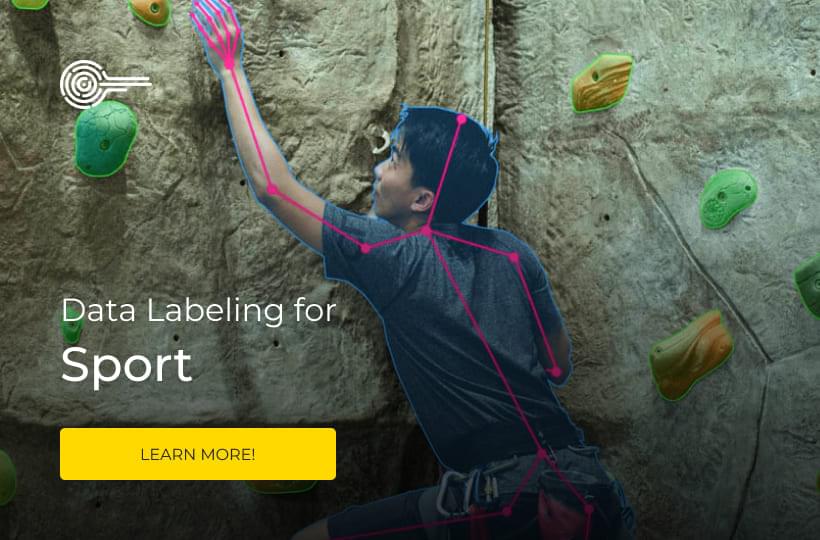
These approaches can complement one another. For example, bounding boxes help a model locate players, tracking helps follow their movements, and keypoint annotation helps analyze body positioning during a specific action. When it is necessary to determine exactly when a pass or shot occurred, temporal annotation is used, linking the event to the corresponding moment in the video.
However, having labeled data does not yet guarantee high model performance. Annotation must follow unified rules, and identical objects and events must be labeled consistently across different frames and recordings. Therefore, preparing sports datasets must include quality control, which helps catch missed objects, identification errors, and inaccurate timestamps before they impact model training.
Ultimately, the effectiveness of sports AI analytics depends on combining high-quality video data, well-chosen annotation methods, and systematic labeling oversight. Such preparation enables models to better navigate game dynamics, more accurately recognize athletes' actions, and provide analysts with information they can rely on when evaluating performance.
FAQ
How does AI distinguish players wearing identical uniforms?
AI models can combine visual features, spatial information, motion patterns, and player tracking to preserve individual identities. However, for this, training data must include examples of how players change positions, occlude one another, and appear from different camera angles.
Can AI analyze multiple sports using the same model?
Some computer vision models can be adapted to different sports, but they will still require additional training data. Each sport has different movements, rules, equipment, and game dynamics that influence how models interpret visual information.
How many video frames should be annotated to train a sports AI model?
There is no universal number. It depends on the sport, model architecture, task complexity, and diversity of available video footage. A smaller yet carefully curated dataset covering various game situations can be more useful than a larger dataset dominated by repetitive examples.
What is the difference between sports video analytics and traditional performance tracking?
Traditional performance tracking often relies on predefined metrics such as running speed, distance covered, or heart rate. Video analytics can provide additional visual context, including player positioning, movement patterns, tactical interactions, and specific in-game events.
Why are multi-camera recordings useful for training sports AI?
Recordings from multiple camera angles provide additional perspectives on players' movements and interactions. This can help reduce blind spots, improve player identification, and support more comprehensive spatial analysis, especially when athletes occlude one another or temporarily disappear from a single camera's field of view.